Thursday, August 12, 2010

A So-Called Schooling Success

If you were to hold my story up next to Sarah's horrendous schooling experience, then I am undeniably a schooling success. My institutional learning began in 1987, at the tender age of four and did not stop (not even for a holiday "gap year" at any point) until I was 24, in 2007. I've completed kindergarten, primary school, and high school (with grades putting me in the top 20% of students in the state for that year). I was accepted into one of the most prestigious universities in the country, completed a three year undergraduate degree with grades good enough for me to be accepted into the one year honours program.

Then I completed a 12,000 word thesis, for which I received first class honours (or an high distinction). The grades I received throughout my honours year were enough to be accepted into the PhD program and win me a government scholarship valued at around $20, 000 a year, for three to four years. A little over half-way through my PhD I discovered I was pregnant and was delighted to have a wonderful, life-changing reason to finally become a drop-out (see Sarah, I'm a drop-out too, I just did it 12 years after you LOL).

Schooling provided me with some incredible opportunities. First it was the method I used to escape an abusive household. Later, I got to travel overseas to speak at a conference. I became a published author in fully-refereed journals and an editor of another journal. I met some incredible individuals, many whom I continue to call my dearest friends. And I developed my research and non-fiction writing skills. for all the good it did me, there was also a lot of harm.

Feeling Smart?

One might assume from reading the accomplishments listed above that I am an intelligent person. But you could not convince me of that until after I left uni!

I believed I wasn't smart because throughout school I was not one of the "smart kids" in class. I remember the first time I got 100% on a test and being thrilled that I might finally get some recognition from my peers and teacher. But the two "smart girls" in class added extra information not asked of students on the test so they got 32/30 for their tests. Even when I did everything right, it still wasn't enough!

Once I was at uni I felt even less intelligent. I was now a little fish in a huge pond, and found it near impossible to get average or above average marks, for the first few years of uni.

Then the PhD experience was a death defying ride in which you never knew if you were going to finish the day curled up in the foetal position under a desk (the bad days). Or passed out drunk in the pub across the road (the good days). Or if you were not going to end your day at all because you had yet to earn sleep on account of working on the world's biggest piece of shit dissertation (most days).

I remember conversations with fellow academics in which we all agreed that being an academic was a never ending battle of "fear and self-loathing". Crying over research was not uncommon, nor was substance abuse. The ability to cope with the pressure was a massive issue and may have something to do with the fact that 70% of people who start PhDs never submit them.

One afternoon I left my supervisor's office and it finally hit me: nothing I did would ever be good enough! The entire system was set up to improve upon what you had in front of you. And once that was improved upon you would have to improve it further. It was never going to end! I looked back and realised I had wasted twenty years of my life waiting for the moment when something I did would be good enough and I would finally feel satisfied with my work!

Socialisation

From my experience the socialising that goes on within school boundaries is completely unhealthy and isolating. The fact that many people see bullying as an important rite of passage speaks volumes on this issue. Just because something happens a lot, doesn't make it okay. You know what else happens a lot: murder, rape, domestic violence, poverty, suicide etc. but few of us would tell our children murder is "character building".

The socialisation I experienced at school taught me that people are inherently nasty and you can't trust anybody. I still struggle to engage in small talk or meet new people because of the negative lessons I took from schoolyard socialisation.

Schoolyard socialisation taught me that to make myself worthy I would have to make myself beautiful (cue dieting and cosmetic surgery), or athletic (cue unhealthy attempts to "improve fitness"), or smart (cue a superiority complex and obsession with ladder climbing). Just being Sazz was not enough.

As for socialisation in class, I was constantly getting in trouble for that. Every report card I have says I do well, but would do better if I could refrain from talking. Socialisation was only permitted from 10:30-11am during recess and 1pm-1:45pm during lunchtime. Never again was socialising so regimented and inhuman as it was at school.

You Can't!

The underlying messages of institutionalised learning are damaging and they're untrue!
  • You can't be trusted to learn in your own time, without threat of punishment.
  • You can't teach yourself new skills, without paying a teacher to tell you how.
  • You can't manage your time wisely, unless we give you a schedule.
  • You can't have a career, unless you do what we tell you.
  • You can't have a happy future, unless you toe the line.
Then there are the "you can'ts" of the grading scale:
  • A maths test comes back with something below a "B": you can't do maths well.
  • You don't win a ribbon at the end of the cross country run: you can't run well.
  • Your textile's teacher has no patience for you: you can't sew.
  • You don't get selected to be in the college musical: you can't sing.
  • You never win an award at speech night: you can't do anything!
I think more than anything else it's the "you can'ts" that hurt, and take the longest to un-do. It's the "you can'ts" that have my heart racing whenever I try my hand at a new skill and my thoughts drift to failure.

Creativity & Failure

Some people claim that school is all about preparing children "for the real world". Uni students are often asked when they're going to join "the real world" and some people believe that home schoolers can't survive "in the real world". So what exactly is the real world, then, if children, uni students/academics and homeschoolers aren't in it?! I really loathe this attitude because it implies that living and learning are not the same thing.

I remember feeling like I was waiting for my life to start, and my decision to keep going to uni was based on the desire to buy more time to figure out what I was going to do with myself when I finally did "join the real world." Meanwhile my life was passing me by.

I spent my "hay day" obsessing over grades, not realising that I was a wonderful, gorgeous, fit and healthy young woman who could do anything any day she chose! I grew up fearing my own autonomy, convinced I couldn't be happy/succeed (coz those are one and the same in the schooling model of life) without rigid structure and an authority looking down upon me.

Creativity is fundamentally important to humanity. I found schooling to be a process of beating creativity out of individuals. It starts with a thoughtless art teacher who tells a young child she's doing it wrong. It progresses to detention for wearing a multi-coloured scarf in your hair instead of the school-approved, uniform-coloured scrunchies. And finally ends with a woman who used to compulsively write fiction for fun, but can no longer bring herself to sketch out the bones of a plot for fear of failure. *sigh*

The Gaps

There are important life skills I am struggling to learn as an adult that were barely (if at all) mentioned throughout my two decades of schooling. Household management is a big one: budgeting, intelligent consuming, balancing domestic duties, paying bills etc. I learned how to pay bills by watching my younger sister, who dropped out of school in year 10, take care of these matters in her own life, years before I had a clue what I was doing.

How to have empathetic and respectful relationships with others is another important topic school skipped. As is almost everything about parenting (aside from the basic lesson "don't get knocked up 'til after graduation"), despite the fact that parenting is the most important job any student will ever have.

The most amusing gap in my education is my lack of understanding when it comes to spelling and grammar (remember I'm a published academic!). I finally figured out the difference between an adjective, verb and noun at the age of 26. I didn't learn it from a text book. I learned it from the following t-shirt:
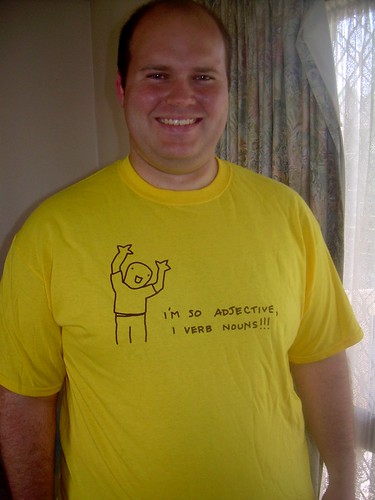
Honestly, The Oatmeal has done more for my grammatical skills than institutional schooling ever did! When I started uni, I discovered that high school had done very little in preparing me. I couldn't research, I couldn't write an essay, I couldn't reference and I sure as shit didn't know what should be referenced. Years later I was disheartened to learn that this was completely normal and got to see it from a totally new angle as the one doing the marking.

Social justice is a super important topic, one that the future of humanity depends upon. But issues of social justice are glossed over at best in primary and high school. If you go to uni and if you take some arts electives you may learn how to think critically and engage with these issues on a more meaningful level. Then there's also the issue of what issues of social justice make it onto the schooling menu. It still baffles me that the majority of adult women can't tell you what feminism is, and people try to claim that Australia is a classless society where racism is a distant memory *shudder*

But back to the gaps in my education. I can't drive a car (fuck, I still haven't earned my pen licence let alone a drivers licence!). Reading instruction manuals and recipes feels much like learning to read did, minus the excitement of a developing plot! My "cooking" leaves a lot to be desired. And I'm about as useful at assembling and repairing household items as Homer Simpson. But for what it's worth I can tell you, from year 9 physics that: a body at rest wants to stay at rest. And from year 12 English: The Riders is a shithouse book.

Something else I sure didn't learn in school was how to write a succinct blog post ;) I've all but given up on that dream!


What Is Success?

I question whether my journey can really be classed as a schooling success? Ultimately it comes down to your definition of success. If you believe the purpose of schooling is to prepare students for "the real world" then no, mine was not a story of success. If you believe the purpose of schooling is to prepare students for a fulfilling career, then no, mine was not a story of success.

Mine, is only a story of success if you believe that the purpose of schooling is to enable students to continue on to do further schooling. But, if like me, you believe success is:
  • Finding a way to be happy within yourself
  • Finding a balance between independence and interconnectedness and
  • Surviving the everyday realities of life
Then schooling has very little to do with success.

ETA (17/08/10): Big thanks to Majikfaerie for sharing the following image on the Liberated Learning forums. I enjoyed a relevant giggle:


Related Posts
You Can Take The Woman Out Of The Institituion, But How Much Of The Institituion Can You Take Out Of The Woman?


Making Monkeys Dance

Online Articles

Unschool Monday: Why?

Unschool Monday: How Does It Work?

Unschool Monday: How Owlets Learn

Unschool Monday: Algebra

Unschool Monday: Fun

No Thank-You, We Don't Believe in Socialization

Socialization: a great reason not to go to school

Monday, August 2, 2010

Choosing To Unschool My Children

When I first heard my friend Sarah mention she was going to homeschool I thought she was crazy. What would she want to do that for? Her kids would turn into unsocialised freaks! The funny thing was that Sarah had had a successful schooling experience and was not going to send her kids to school, but I had had a traumatic schooling experience but was still going to send my kids! Gradually the more I learned about homeschooling, or unschooling in particular, the more it all started to make sense to me.

I started reading stuff online about homeschooling, but I still thought it was something I couldn't do. I wouldn't be able to cope with my kids at home all day. Then I read a blog post by Currawong describing the start to their day. They eased into the day with no rush to get to school. She wrote about how she'd missed out on those moments for years. That one post made me go "oh!", something just clicked and I started seeing it all a bit differently.

I started thinking what sending my kids to school would mean: six hours a day, five days a week with an adult that I might not trust, who they might not get along with. I thought about rushing out the door every morning and being away from them for that long.

Then I started processing my own schooling journey and realised just how much damage it had done to me. I was worried that if I homeschooled that my children would finish up with gaps in their education. But I realised that I had gone to school and still had massive gaps in my education, so there was that excuse gone. I was also worried about homeschooling on my own.

I never wanted to do schooling at home, I knew that wouldn't suit my children and the way our family works. The idea I had had of home schooling was us sitting around a table with me being their teacher and I knew that I couldn't do that. But the more I learned about unschooling the more it seemed possible and suited to our family.

I love the idea of my kids being able to follow their own interests for as long as they want. If they're interested in numbers then they can follow that for as long as they want, the whole day or the whole week, there's no point at which the maths lesson ends. Or if they want to spend a month learning about monkeys they can. They have freedom and autonomy, two things sorely missing from my education.

I didn't want Iris to think that she couldn't learn something just because it wasn't the right time for her to learn it. I had a discussion with my Dad where he remembered the exact moment at which he stopped bothering with maths. He was learning long division in grade three at school and he couldn't understand and he remembers a wall going down in his brain. Forty years later and he hasn't bothered with a single piece of maths beyond that. After that discussion and thinking "what if he was meant to learn it a week or a month later? He might have discovered that he really enjoyed maths and kept learning it. Maybe he would've ended up being a maths teacher instead of a music teacher?" I knew I wanted them to have the chance to learn things when they're ready.

The older Iris gets, the more I realise unschooling is the right choice for her. She is very sensitive and I just don't think most schools and teachers have the times or resources to deal with a child like her. I've been that sensitive child in that school environment and it is not nice! I struggle enough with Iris, having enough patience on a daily basis, and I'm her mother who loves her. I hate to think of how she would be treated in school because the people there don't have the same feelings for her that I do.

Now that the decision is made I'm really excited about our future! Because we're not restricted by school hours or school terms, we're free to travel or spend the day wandering around a museum or digging holes in the dirt in the backyard. Whatever takes their fancy! The possibilities are endless!

Saturday, July 31, 2010

Schooling & Deschooling

I was a very sensitive kid. I would cry at the drop of a hat and I was constantly ridiculed for that, from kindergarten. I remember a teacher told me to sit under a table "like a dog" because I bit another child. It never got any better.

I went to a conservative school and it was hung up on trivial stuff and controlling children's behaviour. So I spent a lot of time in detention for doing things like not eating my bread crusts, crying, wanting to swap sandwiches with my friends etc. I got the cane for calling a sports teacher "a sexist pig" when I was seven (I called him it because he kicked me out of the game). That was 1992.

Then I went to a public school where anything went. There were kids there who were full on, they swore and carried on and all sorts of behaviour I wasn't used to. I had spent so much time getting kicked out of class at my school that I hadn't spent a lot of time in class learning and so I had fallen behind. In grade four I got changed to a different classroom with a different teacher because I didn't get along with that teacher. He physically dragged me out of class one day and I was trying to break free from him and accidentally scratched him. I just wanted him to let me go.

I used to like to read books and do my own thing and this irritated the teachers. I daresay that teacher had been telling me to stop reading and do what he wanted, move to a different space in the room or something, but I kept reading my book.

While I was outside of class after that teacher dragged me out (and I accidentally scratched him) I heard him say to my class of 9 year olds "I hope she doesn't have HIV".

So once I was switched to the other class I pretty much stopped participating. I wasn't coping so I gave up. I brought books to school and I read them quietly, not doing what the rest of class was doing.

When I started high school I ended up at a school that none of my friends went to. I felt like the teachers were picking on me, my science teacher haaated me. She used to threaten me and tell me she would get me kicked out of school. My home room teacher said to me one day "you think you're so fantastic, but you're not" and that was supposed to be the caring one I was meant to be able to go to if I was having problems transitioning into high school.

The other girls in my class started bullying me around that time. They called me "tag along" coz I didn't have any friends. I used to hide in the library and read books, but it was closed to students three days a week so the VCE students could use it without younger kids there.

I had an altercation with my science teacher and the next day I woke up the next day and thought "fuck it, I'm not going". I could see six years of bad schooling behind me and I could see another six or seven years ahead of me and I didn't feel like I could take it anymore. I didn't feel like I had anybody on my side. I said to my Dad "you can't make me go."

Dad got angry and yelled and tried to convince me to go back. Everyone seemed to think it was a phase, that eventually I'd go back to school. No one from school ever chased me up or asked what happened to me. I never went back to high school.

I used to sit at home and read books and watch TV. At one point Dad thought I had dropped out to watch Oprah and the midday show so he took the TV away, thinking it would make me go back to school. It just made me bored. He looked into alternatives for me, schools for kids with behavioural issues, distance education subjects, but it didn't really work. There were no programs or anything to help 12 year old drop outs.

Dad used to threaten me, asking if I wanted to spend my life on a minimum wage. But I was really traumatised by school, enough to not go back.

I taught myself cross stitch and other craftwork. Now when I look back, with the knowledge I have now I can see that I was unschooling myself but it was sabotaged by other people who couldn't see that. I was constantly being told I was a failure because I wasn't at school, because they believed I couldn't learn anything if I wasn't in a classroom.

We had a social worker come to the house and she worked on getting me less fearful and getting me out of the house. She found me a community house that had an education program for adults with learning difficulties.The community house program was meant to be a gentle way to ease back into institutional education. I really enjoyed it because there were only six of us in the room and they were all adults who had chosen to be there. But my teacher told me that she could see that whenever I thought I had got something wrong she could see that I was waiting to be told off. She said she could actually see me "cowering".

When I look back now I think what a pity it was that I wasn't encouraged to follow my own interests while I wasn't in school. All I got from everyone was "if you're not in school you can't learn anything, what are you going to do with the rest of a life, you won't be able to get a job" etc. All of the things I was doing at home to keep myself busy like teaching myself to sew and cross stitch didn't really develop because I was made to feel guilty for doing them because I wasn't doing "traditional" schoolwork.

I'm still interested in the same things I was back then: handcrafts etc. But it's only now (at 25) that I'm getting up the courage to teach myself, after feeling guilty for years and years for "not studying". If I had have been encouraged I'd be an advanced sewer etc. and what a great skill that would be!

To this day the idea of doing "traditional" schoolwork still makes me feel sick to my stomach. It causes me massive anxiety (this is one of the reasons I haven't written blog posts regularly). There are things I've wanted to study but I haven't pursued them because I've been too scared of returning to study, even after thirteen years of being out of the schooling system. I'm still deprograming and deschooling my brain.

Coming to the decision to unschool my girls has helped me realise that there was never anything wrong with me. I'm finally starting to let it go and get the guts to follow my interests and finally looking at studying again.

Tuesday, July 7, 2009

Feminism: Underpinning Our Family Values

"Because women's work is never done and is underpaid or unpaid or boring or repetitious and we're the first to get fired and what we look like is more important than what we do and if we get raped it's our fault and if we get beaten we must have provoked it and if we raise our voices we're nagging bitches and if we enjoy sex we're nymphos and if we don't we're frigid and if we love women it's because we can't get a "real" man and if we ask our doctor too many questions we're neurotic and/or pushy and if we expect childcare we're selfish and if we stand up for our rights we're aggressive and "unfeminine" and if we don't we're typical weak females and if we want to get married we're out to trap a man and if we don't we're unnatural and because we still can't get an adequate safe contraceptive but men can walk on the moon and if we can't cope or don't want a pregnancy we're made to feel guilty about abortion and...for lots of other reasons we are part of the women's liberation movement" -Author unknown, The Torch 14 September 1987.

Feminism is very important to Ealesy and I. It's our opinion that the vast majority of social problems the world faces can be attributed to a system of male dominance sometimes referred to as "the patriarchy" (which loosely defined means "rule of the fathers"). The late great feminist activist Andrea Dworkin describes this concept thusly:
"Sexism is the foundation on which all tyranny is built. Every social form of heirarchy and abuse is modeled on male-over-female domination".

This belief (that all forms of oppression stem from the oppression of women) is a fundamental tennent of radical feminism, one of the major schools of feminist theory with which we* identify.

Some other radical feminist theories include:
  • For women to achieve liberation from male dominance they need a woman identified movement, for women, by women. It cannot hope to be achieved as a by-product of a movement focused on other struggles (whether that be environmental, class, race etc.).
  • Feminism needs to be dedicated to making visible the invisible forms of women's subjugation.
  • Radical feminism is about women teaching themselves, each other and the world to value women, to see the work that women do, how strong, dynamic and inspirational women are, that women are survivors.
  • Feminism seeks to abolish dichotomies that devalue women (eg man vs woman, human vs animal, public sphere vs private sphere, work vs home etc). Radical feminism recognises that women are not the same as men, that they do not need or want to be the same as men. Radical feminists believe women should be equal to men and different to men at the same time.
  • Well-being for all (women, men, children, animals, the environment) depends upon listening to women, learning from women's knowledge. This will save the world; developing new ways of thinking and living based on women's experiences and what they have learned from their unique vantage point as oppressed people in patriarchy.
  • Radical feminism is also about recording all that women do and have done. It is about celebrating women!
  • Radical feminism has a particular focus on bodily issues. While liberal feminists might focus on rights and equal opportunity (and public sphere issues such as getting the vote), radical feminists focus on women's oppression as experienced in and because of their bodily differences from men. This includes, but is not limited to; rape, domestic violence, sexuality, motherhood and reproduction.

We believe that raising our children in a feminist household will give them the skills to become compassionate humanitarians. Feminism is the only truly human rights focused movement because feminists care about women's human rights as well as mens. At the same time, however, feminism is so much more than a human rights movement because the survival of the planet and non-human animals are central issues of concern to feminism as well.

Feminist families such as ours know that patriarchy is oppressive to all, because when the freedom of one group (such as women) is under attack, freedom for all is attacked. Patriarchy prevents women from truly being self-determined, whole persons. Their identities are prescribed to them by social attitudes. In particular women are taught that to be valued they must be feminine (eg, have long hair, be mothers, wear pink, have sex with men, wear dresses, be peaceful and nurture everyone but themselves).

Likewise, men are unable to become truly self-determined persons because they are taught from birth that to be male is to be masculine (eg. have short hair, be leaders, wear blue, don't be attracted to men, sexually conquer as many women as possible, don't wear pink, be aggressive, don't be a wimp). Men fare better than women within this system because all things masculine are valued at the expense of the feminine, but the fact remains that patriarchy oppresses men too because men who deviate from the accepted masculine behaviour are punished, just as the women who deviate from feminine behaviour are punished.

There is hope and parents have great power for creating social change in order to bring about the destruction of patriarchy. Everyday feminist families take small actions that have revolutionary potential such as daring to let their toddler sons grow long hair and wear pink and frills, or their daughters to not wear pink, to play with toy lawn-mowers and trucks as well as dolls etc. We believe that everyday we are creating a happier and safer future for all by raising our children with feminist values.
“A feminist world is a community where...women are safe anywhere any time....the weapons of war and other wasteful and destructive toys of technology have disappeared; people of the world work together to develop an economy that benefits all of us and conserves the planet; trust replaces fear, love replaces violence, and these hateful times are relics in the archives of patriarchy.Statement issued by Women’s Pentagon Action, 1980.
For more about feminism check out the following links:
The Online Feminist Workshop

http://www.offourbacks.org/

The Feminist Theory Website

Feminist Issues

Prostitution Research and Education

Hands Off Our Ovaries

Feminist Quotes

More Feminism Quotes

Stop Violence Against Women

Coalition Against Trafficking Women


F-Agenda

Feminist Books


Introductions


Feminist Thought

Feminism is For Everyobody

Feminist Politics and Human Nature

Public Man Private Woman


Black & Indigenous Feminism


Aint I a Woman?

Talkin' Up to the White Woman

Black Feminist Thought

Feminist Theory from Margin to Center

Book List

Book List I


Ecofeminism


Ecofeminism

Ecofeminism: Women, Culture Nature

Ecofeminism: Women, Animals, Nature

Feminism and the Mastery of Nature

Animals and Women

Wild Politics


Radical Feminism


Gyn/Ecology

Radically Speaking

The Sexual Contract

Man-made Women

Right Wing Women

The Whole WomanThe Scum Manifesto

Heaps more Here

Marxist and Socialist Feminism

The Radical Women Manifesto

The Dialective of Sex

Book List

Book List I

Issues

On Motherhood


Of Woman Born

The Mask of Motherhood

From Motherhood to Mothering

The Mother Machine

Our Bodies Our Babies

Defiant Birth

Motherhood: power and oppression


On Pornography & Prostitution


Not For Sale

The Idea of Prostitution

Prostitution, Trafficking and Traumatic Stress


On Violence


The Will to Violence

The Demon Lover

Life and Death


On Appearance


Beauty and Misogyny

The Beauty Myth

Fat is a Feminist Issue


On Revolutionary Diet

The Sexual Politics of Meat

The Pornography of Meat

Political Palate


On Patriarchy coming between Women

Female Chauvinist Pigs

A Passion for Friends


Sisterhood is Global

Classics


A Room of One's Own

Three Guineas

The Second Sex

The Female Eunuch
Famous Feminists

Simone de Beauvoir

Patricia Hill Collins

Andrea Dworkin

Germaine Greer

bell hooks

Sheila Jeffreys

Maria Mies

Val Plumwood

Vandana Shiva

Virginia Woolf


*It should be noted that while Ealesy is a pro-feminist man he cannot be a feminist himself. In his own words:
"I had a male teacher in grade 10 who was always telling us he was a feminist, but it never sat right with me. I don't understand how he could have any real understanding of the oppression women face in everyday life and as such could not be a feminist.


I identify as pro-radical feminist as I agree with the arguments this group puts forward and support the stances they take on a number of issues. However, having never been a woman or subject to the oppression they face in their daily life, I would find in condescending and patronising to suggest I was a feminist."

As for me and whether all women can be feminists or not, we refer to the words of Gloria Steinem "In my heart, I think a woman has two choices; either she's a feminist or a masochist."


Tuesday, September 23, 2008

Notes To Self

I've been giving myself a bit of a hard time lately (and by lately I mean for about the past 25 years lol). I'm feeling a bit paranoid about parenting like my parents did, of my child ever feeling the way I did. I have an urge to wrap her up in cotton wool and lock her in a cell where nothing could ever happen to her - you know, coz I couldn't possibly let her live her life, that's far too scary!

Then I get exposed to free spirited parents like Majikfaerie and kick myself for going about it all wrong.

Bub tries to crawl and I want to stop her because I can see ahead and know she's going to fall and get upset. So what do I do? Do I let her get hurt, get upset? Or do I protect her? This mothering caper is making me realise how uptight I am, and how controlling I am.

Even my initial motivations for wanting to freebirth and homeschool were about control. I wanted to control every aspect of my birth experience and my children's education. Of course I realise now that I can't do either of those things, and I don't want to do those things because that would make them other than they are meant to be. And I realise that the whole beauty of learning and birthing is that we can't control them! To control is to stifle and ultimately destroy.

So I've been challenging myself to BACK OFF. My child is going to get hurt, that's just a reality of life. Falling over is part of learning to crawl (and later to walk).

I'm also worried about not enjoying the moments and being present with my bub. I don't want to look back years down the track and think "shit, I wish I had have stopped to smell the roses, I wish I had have actually forgotten about the rest of the world and just sat with her on the floor and be with her, rather than cleaning the house or wishing she was asleep so I could have a break :("

I've also been thinking about something Anna said at the doula course on the first day. She said we should be practicing to be a doula every day of our lives. I'm of the opinion that at birth I am a fabulous doula. I'm present to the moment, and reflexive and thoughtful and calm and attentive and flexible. I don't feel like I am any of those things in my everyday life. I want to endeavour to treat Ealesy and Harri with the same love and respect I find so easy to give to birthing women.

My notes to self are:
  • Chill the fuck out, dude!
  • Doula Harri & Eale/Be present with them and for them

Saturday, August 23, 2008

Making Monkeys Dance

I've recently discovered that I really don't like these two terms; "training" and "schooling". They both imply something sinister to me; that you don't have what is needed to do a certain task or perform a certain skill, and someone superior to you (external to you) is going to bestow their talent on you, if you do as you're told. "Dance monkey, and you will be rewarded with shiny yellow banana". It irks me.

I have come to realise recently that learning a new skill or task or profession is really just a process of discovering the talents and skills you already had within yourself that will be most useful to this new thing. You are not without at the beginning of learning something new. This is something just dawning on me, which I still struggle with (I get very flustered at the start of trying something new and feel inferior and "stupid" because I can't do this new thing that others can - like knitting!!! I'm also realising that my excitement for studying, doing courses, and getting qualifications comes from feeling "without" and hoping to fill that void with something. Of course that never works, and so the professional student is born!).

No two individuals are the same, therefore no two doulas or authors or academics are the same. But schooling and training treat all students the same. They learn the same cirriculum and are given the same answers for the same questions and problems, and this is supposed to equip them for their new identities as the learned folk. Of course it doesn't, and the more we live the more we realise how much time was wasted in schooling institutions and how little we gained from "studying". The best form of studying is living! Life is on the job training.

I'm also beginning to realise how meaningless the terms "student" and "teacher" are. We are all students our entire lives. We never stop learning! To do so would be incredibly dull! It would make life pointless. But we are also always teachers because by being ourselves and sharing our natural gifts with others we help others learn new things and realise their own skills in similar areas.

Anyway, we won't be "homeschooling" our daughter. We won't be schooling any of our children. We don't want a pack of trained monkeys. We will nurture and guide our child's natural learning journey while she lives at home. And when she's an adult we will continue to support her as she continues her natural learning journey.

Thursday, April 17, 2008

You Can Take The Woman Out Of The Institution. But How Much Of the Institution Can You Take Out Of The Woman?

My partner and I believe homeschooling is the best education option available to us, so I've been looking into it and having my mind blown wide open by what I've discovered. One of the sites I found had an emphasis on unschooling or natural learning, which I had heard of but didn't really understand. Basically it is home learning, but it is not schooling. The parent doesn't become the teacher in natural learning, they don't set curriculum, or goals or assignments and they don't grade. With natural learning the agent of learning is the student themselves. The student follows her own natural curiosity and interests which leads to her taking up her own assignments (though projects or activities is a far more appropriate word). Learning is understood to be a never ending journey, and the focus is on enjoying the journey rather than reaching goals. It's self motivated and regulated, parents trust their children to learn what they need to and don't worry about the rest. The parent is a guide, rather than a teacher, who enables the child to grow, discover, and get active.

Researching schooling options for my daughter has got me reflecting on my own experiences with institutional learning and has set me on an exciting new journey of self discovery. Initially the thought of learning without a curriculum seemed impossible and absurd to me (particularly given that I am a control freak). How could a child learn without a rigid curriculum? I wondered. But then I asked myself "have curriculum's always served my learning well?" My questioning led me to confront a few myths within my own learning philosophies. Three such myths are: certain activities should only be learned as a child, you can't learn without a certified instructor whom you pay, and you can't learn without a rigid curriculum.

MYTH 1: Certain Activities Should be Learned as a Child.

When I was a child I was one of the key members of a dance company. I left the company when I was eight, it was getting too intense and they were already pressuring us to treat our dancing like a career rather than a hobby. I have missed dancing for many years, but have been reluctant to take it up again because "dance is something you do as a child". Similarly, I nearly talked myself out of pursuing one of my life long dreams because of this myth. I have always wanted to play the clarinet, but at nineteen I told myself it was "too late" for me. Learning a musical instrument is something you start in school.

I believe this myth came to be a part of my philosophy about learning because of the rigid and predictable curriculum's taught in schools. At the schools I attended everyone learned exactly the same topics, from the same people and the same textbooks in the same year level. We all knew that you read book x in year x, and x subject is an elective option in year x. Music was an elective from year 7 to 9 and I skipped it.

MYTH 2: You Can't Learn Without an Instructor.

Thankfully at twenty I realised how ridiculous and limiting it was to tell myself I was too old to learn to play a musical instrument, and at twenty one I got a clarinet and found a teacher whom I adored. After a year of living one of my dreams my teacher moved overseas and has not returned since. My clarinet has collected dust because I haven't found a teacher to replace the one whom I loved so dearly, and because it didn't occur to me that I could learn to play a musical instrument without a teacher telling me how.

Within the institutional setting there is teacher, who is the expert, who plans lessons, who manages and directs lessons. The teacher is the agent of learning. Then there is the student, who is unknowing, who shows up at the specified time and place and does as she's told. The student is dependent on the teacher. Having graduated from twenty years of learning in institutional settings (1 year of kindergarten, 7 years of primary school, 6 years of secondary school, and 7 years of university, which included a couple of postgraduate years) I had become subconsciously convinced that I need a dominant expert in order to learn.

MYTH 3: You Can't Learn Without a Rigid Curriculum.

In year seven I was at the top of my French class, the following year I changed schools and French was not offered at my new school. I still wanted to learn French, so when I got to uni I took it up again but failed miserably! I found that the university classes moved too fast for me, and focused on how to say words and sentences without actually giving students an opportunity to try saying words and sentences for themselves. After giving up on French class at uni I bought myself a set of teach-yourself French books and tapes. I gave myself daily goals and made my way through the tapes and pages with my strict curriculum, which was based on having a certain number of sections completed within a certain number of hours. I ended up getting bored and distracted and made it through only one tape! After that I enrolled myself into an adult education course at night. This class moved too slowly for me and I ended up becoming an unofficial teacher's aid, helping the other students with their French rather than improving upon my own.

Finally, a year later I went to Canada and spent a couple of weeks in Quebec. In those few weeks I understood and spoke French better than ever. There were certain phrases or rules within the language that I thought I hadn't grasped in classes but they just fell into place on holiday. One day I had a conversation with a Frenchman in a hostel and I understood him perfectly even though I'd never formally learned the words or sentences he was using! Of course now I'm home and without opportunities to converse in French. But I know now that if I were to go back to Quebec or go to France I'd be fluent fairly quickly.

I have always felt deep down that I am a dancer, clarinet player and French speaker LOL, but thanks to my own flawed assumptions about how people learn, I have kept myself from actually being any of those things. When I think about the things that I know myself to be already (for example a swimmer, a writer, a card maker, a freebirther, and an attached mother) I realise that I did not become any of those things by learning them just as a child, or by paying a teacher, or with a strict curriculum. In fact, I began each of my journey's to becoming those things outside of an institutional setting. I became those things by following my heart and doing what made her happy. In the case of swimming, writing and card making it was because I enjoyed doing these activities I continued to do them over and over again and consequently honed my skills and ended up becoming a competitive swimmer, and published writer.

Fear, Failure, & an Unfortunate Focus on the Future

When we learn for the love of learning and the joy of an activity that sparks our interest we become fearless in our pursuit for knowledge. As a child I jumped into the water without a care for who was watching me, without any goals or thoughts for my future. I swam purely in the moment. Eventually I became a strong swimmer because I spent so much time in the water enjoying myself, I didn't realise this would lead me to new opportunities such as being part of a team, and meeting new people and seeing new towns every week.

I attribute this fearlessness to the absence of the possibility of failure in natural learning. I never stopped being a strong swimmer despite giving up the competition. Whereas with dance, clarinet and French, skills that I am coming to as an adult, I have a lifetime of baggage about the expectations and judgments of others, and a fear of failing.

When I first wanted to make a card I couldn't get started. I had all the materials and tools for months, but I couldn't bring myself to actually start making a card. I was convincing myself that I couldn't do it, that I would ruin the materials if I began cutting and pasting. Twenty years of institutional learning had left me feeling like I had to take a class, someone had to tell me how to create. Then one day I ignored the voices and made a card without thinking about how it would look when I finished. Just as I had once been in the pool, I focused on doing, and being in the moment. I ignored my fears about the future of the materials and whether my end product would be a success or a failure. And I found that I had always had the power, vision, and talent to make my own cards within myself.

From that moment I made all the cards I gave to people, and I have never been unhappy with one of my finished products. And yet every time I start to make a new card I still have that little voice of fear wondering if I will make something good, trying to scare me away from getting started. Every time I start I tell that voice to be quiet, forget all thoughts about the future, and I throw myself into doing. The difference is now it only takes a few seconds, rather than a few months, to silence the fear mongering voices.

Now that I think about it, if we are truly learning, and learning for the love of learning, and doing for the love of doing, then failing isn't really possible, because the goal is not to succeed, it is to learn. It's about the journey, not the destination. That is the biggest difference between learning in an institutional setting and unschooling. In an institutional setting the journey is made less enjoyable by a focus on the end point and getting there in a set timeframe. Where with natural learning you don't really have an end in mind, so you can't fail to get there. And your timeframe is a lifetime.

Inspired by these new discoveries, I have decided to do the following:
  • I will get my clarinet serviced when we've got cash to do so and I will take to playing around on it and learning on my own.
  • I will look into local dance schools and when the baby permits I will join one that has an emphasis on being social rather than professional
  • And at some stage in the future I will see if I can find a community of French speakers to hang out with and learn in a casual environment rather than a class.